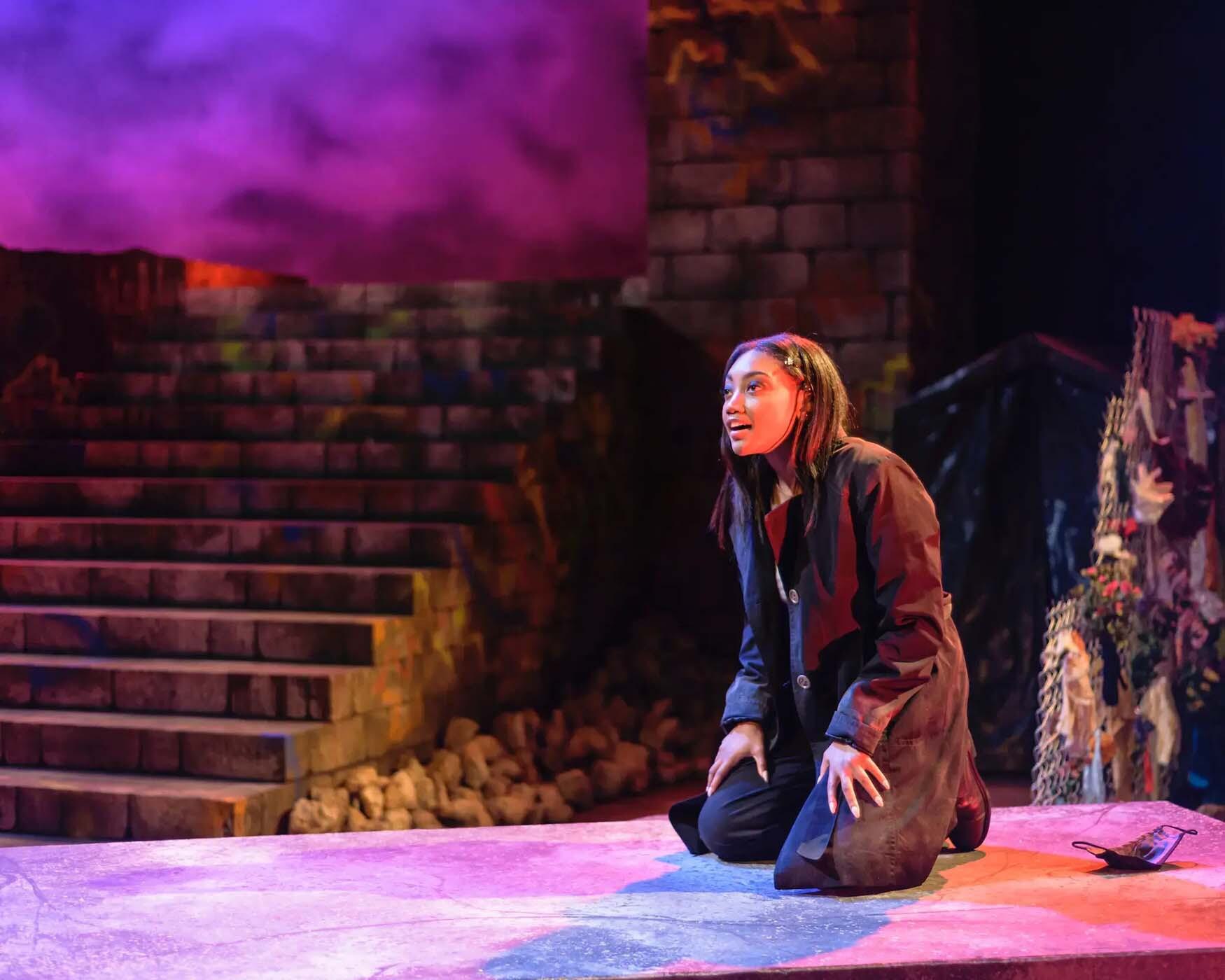
The School of Theatre's BFA in Acting is a pre-professional training program. It combines the best of conservatory/studio training with the breadth of the general education requirements that have made Â鶹´«Ã½Ó³» one of the best small universities in the U.S. There are two tracks that students can choose for the BFA Acting degree: Stage and Screen track and On-Camera track. Both share very similar classes for the first two years and then split off into specialized training courses. See below for highlights of the two tracks and the PDF versions of both of their curriculums.

| COURSE NUMBER | COURSE TITLE | CREDIT HOURS |
|---|---|---|
| THRE 1413 | Acting Company 1 | 3 |
| THRE 1013 | Freshman Actor Workshop | 3 |
| THRE TECHNICAL | 3 | |
| THRE 1023 | The Actor's Instrument I | 3 |
| ENGL 1113 | Composition I | 3 |
| Elective (dance or voice) | 1 | |
| FYE 1000 | Becoming a Star at Â鶹´«Ã½Ó³» | 0 |
| Total Credits | 16 |
Second Semester
| COURSE NUMBER | COURSE TITLE | CREDIT HOURS |
|---|---|---|
| THRE 1503 | Acting Company II | 3 |
| THRE 1XX3 | The Actor's Instrument II | 3 |
| THRE 1113 | Play Analysis | 3 |
| THRE TECHNICAL | 3 | |
| ENGL 1213 | Composition II | 3 |
| Elective (Dance or voice) | 1 | |
| Total Credits | 16 |
| COURSE NUMBER | COURSE TITLE | CREDIT HOURS |
|---|---|---|
| THRE 2403 | Acting Company III - Contemporary Scene Study | 3 |
| THRE 2003 | Vocal Production for the Actor | 3 |
| THRE TECHNICAL | 3 | |
| HISTORY | 3 | |
| MATHEMATICS | 3 | |
| DANCE, VOICE, OR MAKEUP LAB | 1 | |
| Total Credits | 16 |
Second Semester
THRE
| COURSE NUMBER | COURSE TITLE | CREDIT HOURS |
|---|---|---|
| THRE 2503 | Acting Company IV - Chekov | 3 |
| THRE 2103 | Movement for the Stage | 3 |
| THRE 3013 | Vocal Production for the Actor II | 3 |
| THRE TECHNICAL | 3 | |
| RELIGION | 3 | |
| DANCE, VOICE, OR MAKEUP LAB | 1 | |
| Total Credits | 16 |
| COURSE NUMBER | COURSE TITLE | CREDIT HOURS |
|---|---|---|
| THRE 3203 | Acting Company V - Shakespeare | 3 |
| THRE 3223 | Theatre History and Historiography | 3 |
| THRE 4103 | Movemet for the Stage II | 3 |
| MODERN LANGUAGES I | 3 | |
| LITERATURE | 3 | |
| DANCE, VOICE, OR MAKEUP LAB | 1 | |
| Total Credits | 16 |
Second Semester
| COURSE NUMBER | COURSE TITLE | CREDIT HOURS |
|---|---|---|
| THRE 3963 | Special Topics in Acting | 3 |
| THRE 3233 | Seminar in Theatre History Topics | 3 |
| THRE 4003 | Voice Training & Dialects | 3 |
| THRE 3963 | Special Topics in Acting | 3 |
| MODERN LANGUAGES II | 3 | |
| DANCE, VOICE, OR MAKEUP LAB | 1 | |
| Total Credits | 16 |
| COURSE NUMBER | COURSE TITLE | CREDIT HOURS |
|---|---|---|
| THRE 3124 | Audition Techniques | 4 |
| THRE 3513 | On-Camera Acting | 3 |
| METHODS OF SCIENTIFIC INQUIRY | 3 | |
| INTEGRATED SCIENCE LAB | 1 | |
| PHILOSOPHY/ETHICS | 3 | |
| DANCE, VOICE, OR MAKEUP LAB | 1 | |
| Total Credits | 16 |
Second Semester
| COURSE NUMBER | COURSE TITLE | CREDIT HOURS |
|---|---|---|
| THRE 3963 | Special Topics in Acting | 3 |
| THRE | Advanced On Camera Acting | 3 |
| GOVERNANCE IN AMERICA | 3 | |
| SOCIAL SCIENCE | 3 | |
| Total Credits | 12 |
| COURSE NUMBER | COURSE TITLE | CREDIT HOURS |
|---|---|---|
| THRE 1413 | Acting Company 1 | 3 |
| THRE 1013 | Freshman Actor Workshop | 3 |
| THRE 1043 | Intro to On-Camera Acting | 3 |
| THRE 1023 | The Actor's Instrument I | 3 |
| ENGL 1113 | Composition I | 3 |
| Elective | 1 | |
| FYE 1000 | Becoming a Star at Â鶹´«Ã½Ó³» | 0 |
| Total Credits | 16 |
Second Semester
| COURSE NUMBER | COURSE TITLE | CREDIT HOURS |
|---|---|---|
| THRE 1503 | Acting Company II | 3 |
| THRE 1XX3 | The Actor's Instrument II | 3 |
| THRE 1013 | Intro to Film Studies | 3 |
| ENGL 1213 | Composition II | 3 |
| HISTORY | 3 | |
| Elective | 1 | |
| Total Credits | 16 |
| COURSE NUMBER | COURSE TITLE | CREDIT HOURS |
|---|---|---|
| THRE 2403 | Acting Company III - Contemporary Scene Study | 3 |
| FILM 2123 | Film Editing Foundations | 3 |
| FILM 1024 | Intro to Film Workshop | 4 |
| FILM 2013 | Writing for the Screen | 3 |
| MATHEMATICS | 3 | |
| Total Credits | 16 |
Second Semester
THRE
| COURSE NUMBER | COURSE TITLE | CREDIT HOURS |
|---|---|---|
| THRE 2503 | Acting Company IV - Chekov | 3 |
| THRE 2103 | Movement for the Stage | 3 |
| FILM 2024 | Intermediate Film Workshop | 4 |
| RELIGION | 3 | |
| LITERATURE | 3 | |
| Total Credits | 16 |
| COURSE NUMBER | COURSE TITLE | CREDIT HOURS |
|---|---|---|
| THRE 3543 | Acting for Film and TV I | 3 |
| FILM 3423 | Advanced Film Workshop | 3 |
| THRE TECHNICAL | 3 | |
| MODERN LANGUAGES I | 3 | |
| FILM 4113 | Directing for the Camera | 3 |
| MAKE-UP | 1 | |
| Total Credits | 16 |
Second Semester
| COURSE NUMBER | COURSE TITLE | CREDIT HOURS |
|---|---|---|
| THRE 3623 | Acting for Film and TV II | 3 |
| THRE 3983 | Special Topics in Screen Acting | 3 |
| MODERN LANGUAGES II | 3 | |
| PHILOSOPHY/ETHICS | 3 | |
| SOCIAL SCIENCE | 3 | |
| Elective | 1 | |
| Total Credits | 16 |
| COURSE NUMBER | COURSE TITLE | CREDIT HOURS |
|---|---|---|
| THRE 3124 | Audition Techniques | 4 |
| THRE 3633 | Acting for Film and TV III | 3 |
| FILM 3213 | Film Theory Criticism | 3 |
| METHODS OF SCIENTIFIC INQUIRY | 3 | |
| INTEGRATED SCIENCE LAB | 1 | |
| Elective | 2 | |
| Total Credits | 16 |
Second Semester
| COURSE NUMBER | COURSE TITLE | CREDIT HOURS |
|---|---|---|
| THRE 3963 | Special Topics in Acting | 3 |
| THRE 3983 | Special topics in Screen Acting | 3 |
| THRE 3643 | Acting for Film and TV IV | 3 |
| FILM 4003 | Producing | 3 |
| GOVERNANCE IN AMERICA | 3 | |
| Elective | 1 | |
| Total Credits | 16 |
Today’s rapidly changing industry is craving artists who put their whole being on the line, turning on a dime between intimate, emotional vulnerability and bold, physical risk-taking. Theatre is becoming an athletic event, requiring artists who can fill the physically expressive demands of modern audiences and directors. We strive to unlock the boundless creativity of the next wave of performers with bold movement training that reconnects students to their primal impulses and then shapes those impulses into articulate and inspiring expressions. We believe this is best accomplished through a select combination of approaches.
“Contact improvisation is the beauty of natural movement combined with complete communication.� ~ Curt Siddall
A central element of any fine performance is an uninhibited, continuous flow of communication. In order to achieve this open exchange of communication we have to un-learn our fear. Fear of judgement. Fear of failure. Fear of conflict. A child’s natural state is to trust. She doesn’t know that the flame on the stove will hurt her until she reaches out for it and gets burned. The first time he gets his heart broken he learns not to rely on other people. Our fear response, while necessary to avoid pain in everyday life, can become a hindrance to actor training and a significant blockage of communication. Through simple weight-sharing exercises and ensemble-building techniques, Contact Improvisation teaches students to revert to their primal state of trust: trust in self and trust in others. Once this door is opened the floodgates of creativity and confidence soon follow.
“When you know what you do, you can do what you want.� ~ Moshe Feldenkrais
Moshe Feldenkrais studied the development of infantile movement in order to understand the primal urges that drive us to move and organize ourselves so we can function. He realized that by returning to those fundamental organizing patterns he would connect his students to the essential elements of movement and thereby eliminate their reliance on the unnecessary stresses that people acquire throughout life. This return to our primitive essence brings them out of the shadows of mindless habit and ushers them toward a life that is lived with intention and purpose. Through the use of Feldenkrais’ Awareness Through Movement®and Functional Integration® lessons, students gain a deep personal understanding of their bodies which may have been on auto-pilot for over a decade. Once they are equipped with a more conscious awareness of themselves they have the ability to turn habits into choices.
“Artists and scientists are activists. They look at the world as changeable and they look upon themselves as instruments for change. They understand that the slice of world they occupy is only a fragment but that the fragment is intrinsically connected to the whole. They know that action matters.� ~ Anne Bogart
These two methods of actor training are fast becoming some of the most widely practiced in the industry. The combination of improvisation, discipline, and precise storytelling create an immediately accessible vocabulary for artists in any part of the work and any part of the world. While Tadashi Suzuki’s exercises require an unprecedented level of physical control and imaginative investment, Anne Bogart’s Viewpoints & Composition training gives students a logical framework on which to hang the chaos of human experience.
“The successful warrior is the average man with laser-focus.� ~ Bruce Lee
Every BFA Acting student at Â鶹´«Ã½Ó³» is trained in basic unarmed and single sword technique in keeping with the standards set forth by the Society of American Fight Directors. In addition to the in-class training there are also a multitude of regional SAFD weekend workshops that immerse students in a wide variety of weapons and physical disciplines, as well as provide a critical networking opportunity with some of the top working professionals in the country. Some of the weapons that have been covered in class are unarmed, single sword, rapier & dagger, quarterstaff, kali sticks, and poi spinning.
Voicework is essential for performers. We explore the voice-body connection through the lens of voice, and breathwork. Developing coordinated vocal and physical habits will allow you to present a more authentic performance. Authenticity comes from your ability to connect with text and bring it to life.
Our voice curriculum draws from a wide combination of pedagogical influences including but not limited to: , , , Emotional Effector Patterns, and . Our classes help develop a creative habit that not only caters to the artist's performance skills, but serves the artist outside of the rehearsal hall. The work reinforces resilience, sustainable practices, connection, flexibility, stamina, variety, and vocal health required to sustain a career in the arts.
Actor's Instrument: A first-year introduction to the voice and the body for the actor, rooted in developing body awareness, breath awareness and cultivating presence. Students will explore personal awareness of habits and blocks that limit vocal nuance and physical ease in performance. They will gain a beginning understanding of basic vocal anatomy, how the voice works and why it may not. Students will connect vocal production to text through imagistic poetry, storytelling, creating a concrete warm up, and exploring vocal variety.
Vocal Production 1: An introductory professional voice course designed to expand body-breath awareness, and the ability to identify and release tension in the body that obstructs the natural expression of the self. Students work to condition vocal stamina sufficient for handling heightened text, supporting physically active and demanding texts, and sustaining long thoughts. The student will gain the ability to adjust their personal style to accommodate and express a wide variety of dramatic and non-dramatic texts from a range of periods and styles through use of body and voice.
Vocal Production 2: A continuation of the advanced professional-training voice course designed to build on the practice of Voice 1. The course challenges the student to transcend the work of Voice 1 to develop a deeper understanding of body and breath.
Voice Training & Dialects: This course in dialects is intended to develop the foundation of clear and authentic dialects for performance through a process that is descriptive not prescriptive. Students will learn the International Phonetic Alphabet. They will develop a familiarity with the musculature and structure of the oral cavity and how this can be manipulated to produce authentic sound. They will develop the ability to breakdown and learn different accents that will serve their individual identities.


